Beside the other provers, 2026-10-15
One run of deduxit and the other provers of linear logic on the same
4 811 problems (the LLTP library, qcover's coverability problems and
deduxit's generated families), on 2026-10-15 on an Intel Core Ultra X9
388H (16 cores, 64 GB, Linux 7.2.9): the sequential tools and deduxit's
one-thread column each on one efficiency core (cores 6–11, six streams
side by side), deduxit's default on the four low-power cores (12–15),
every run under 10 s and 4 GiB, measured by BenchExec 3.27. deduxit was
built from commit 60226b2c, every other tool at the version the flake
pins. The rows are bench/comparison/2026-10-15/runs.csv (62 543 runs),
the tables ranking.md beside them, and
bench/TOOLS.md
says how each tool was run and discusses every result; the tables below
are its own.
Solved within 10 s
| tool | solved | proved | unprovable | wrong | ended at the limit | out of memory | the tool's bound | error | outside its fragment |
|---|---|---|---|---|---|---|---|---|---|
| deduxit, default (4 low-power cores) | 4 204 | 3 907 | 297 | 0 | 547 | 1 | 59 | 0 | 0 |
| deduxit, one thread | 4 181 | 3 899 | 282 | 0 | 571 | 0 | 59 | 0 | 0 |
| Sympli | 1 684 | 1 439 | 245 | 0 | 1 935 | 876 | 0 | 0 | 316 |
| Maude, ILL | 768 | 742 | 26 | 0 | 2 940 | 71 | 700 | 16 | 316 |
| APLL, ILL | 612 | 544 | 68 | 1 296 | 2 015 | 20 | 412 | 140 | 316 |
| llprover, ILL | 479 | 453 | 26 | 0 | 3 857 | 0 | 19 | 140 | 316 |
| LinearOne | 69 | 46 | 23 | 0 | 0 | 0 | 0 | 0 | 4 742 |
| APLL, LL | 31 | 22 | 9 | 12 | 78 | 0 | 13 | 0 | 4 677 |
| Click & coLLecT | 31 | 23 | 8 | 12 | 91 | 0 | 0 | 0 | 4 677 |
| Maude, LL | 31 | 20 | 11 | 0 | 82 | 21 | 0 | 0 | 4 677 |
| linTAP | 15 | 14 | 1 | 0 | 37 | 21 | 0 | 0 | 4 738 |
| lolli | 14 | 14 | 0 | 0 | 54 | 35 | 23 | 6 | 4 679 |
| llprover, LL | 11 | 10 | 1 | 0 | 123 | 0 | 0 | 0 | 4 677 |
A wrong verdict, a refutation of a problem some tool proved with a checked proof or a verdict against a generated problem's by construction, never counts as solved.
| problems | deduxit | deduxit, default | Maude | llprover | Sympli | APLL | LinearOne | Click & coLLecT | linTAP | lolli |
|---|---|---|---|---|---|---|---|---|---|---|
| LLTP intuitionistic, 1 358 | 829 | 852 | 613 | 479 | 873 | 548 | 69 / 69 | – | – | – |
| LLTP Petri nets, 3 137 | 3 072 | 3 072 | 155 | 0 | 811 | 64 | – | – | – | – |
| LLTP classical, 17 | 17 | 17 | 12 | 10 | – | 13 | – | 15 | 2 / 6 | 7 |
| qcover, 176 (intuitionistic affine) | 162 | 162 | – | – | – | – | – | – | – | – |
| generated families, 123 | 101 | 101 | 19 / 117 | 1 / 117 | – | 18 / 117 | – | 16 / 117 | 13 / 67 | 7 / 115 |
A dash is a set outside the tool's fragment or mode; n / m where the
tool covers only m of the set.
The cactus plots
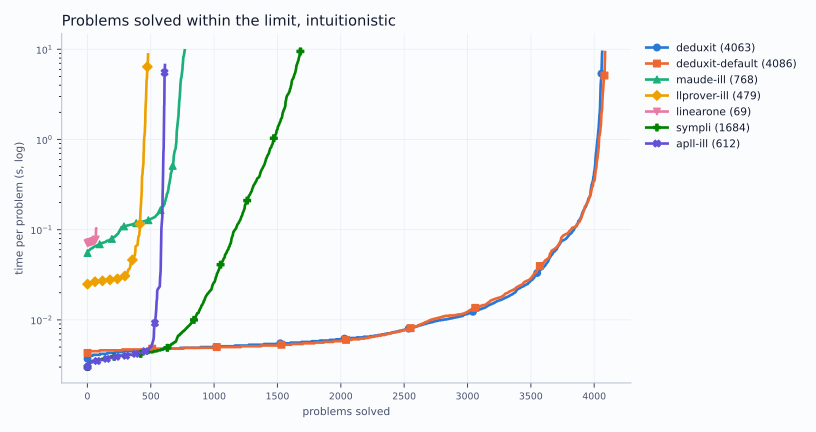
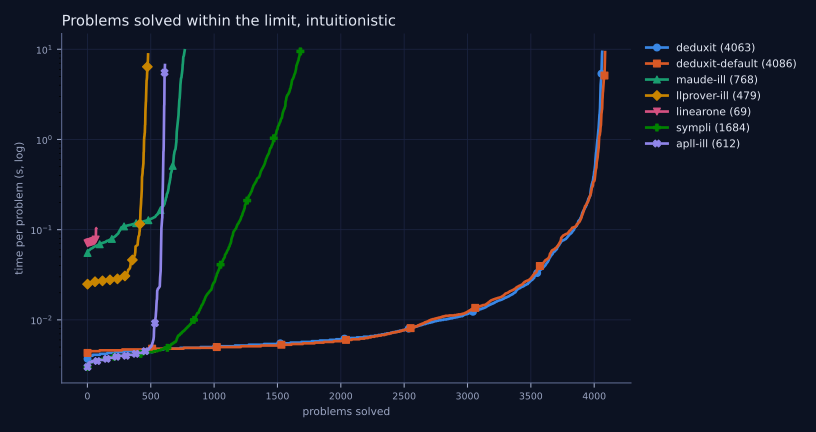
Intuitionistic problems. For each tool, the problems of the intuitionistic modes (the LLTP library, its Petri nets and qcover) it solved within 10 s, sorted by the time each took, against that time on a logarithmic axis; the legend gives each count. A line further right solves more and a lower one solves faster: both of deduxit's columns solve over 4 000, most of them Petri nets, at a median of 6 ms, and Sympli, the next, 1 684.
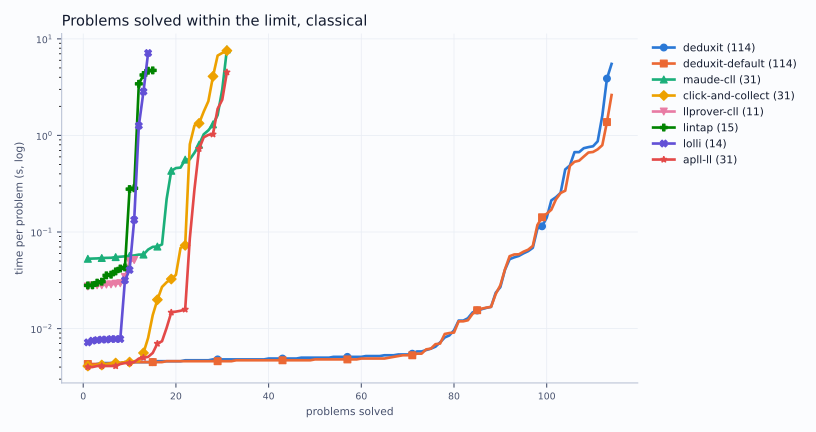
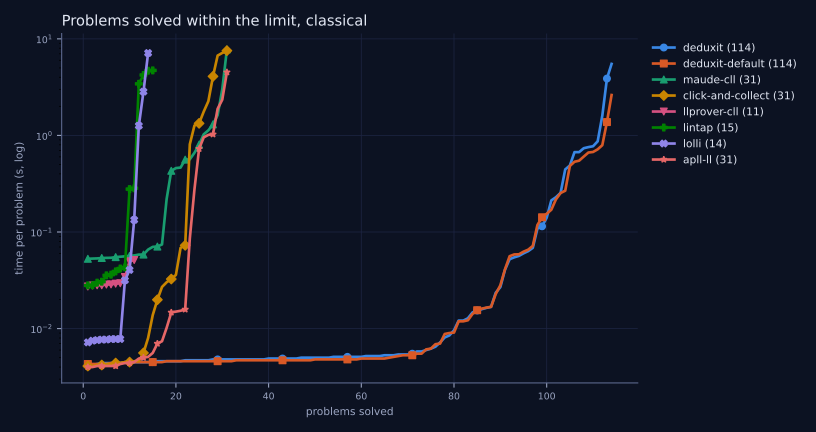
Classical problems. The same for the classical problems (the LLTP library's classical files and the generated families): deduxit solves 114, the other tools between 11 and 31, which most of them reach at times where deduxit's line is still flat.
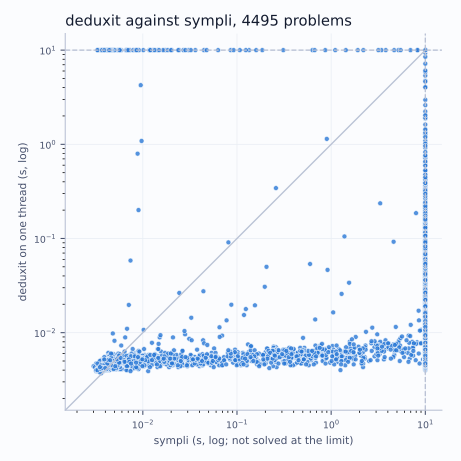
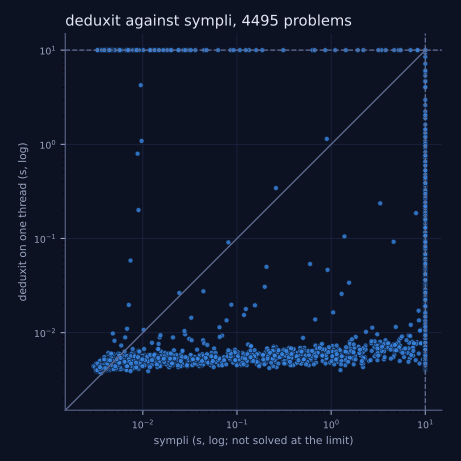
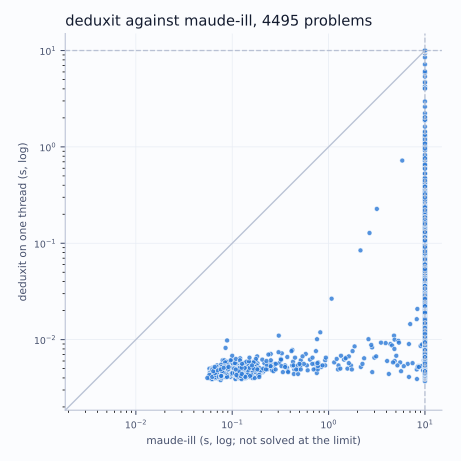
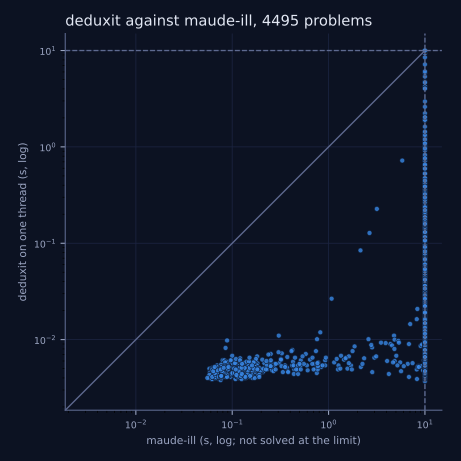
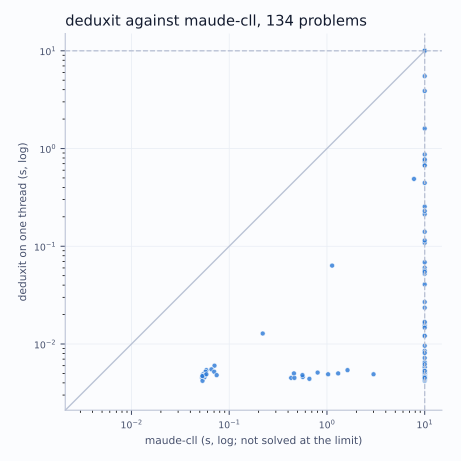
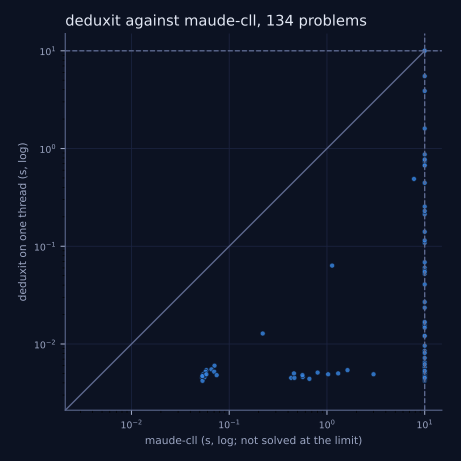
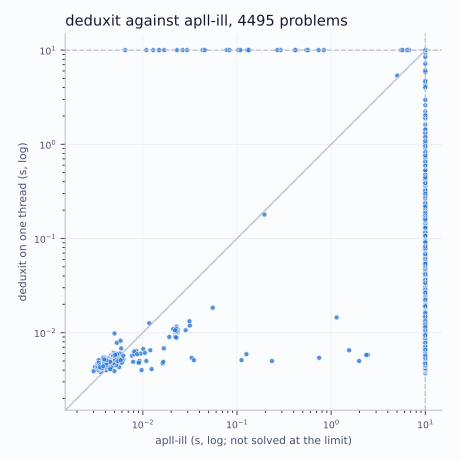
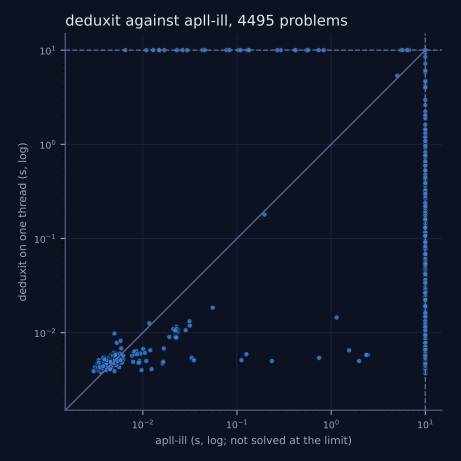
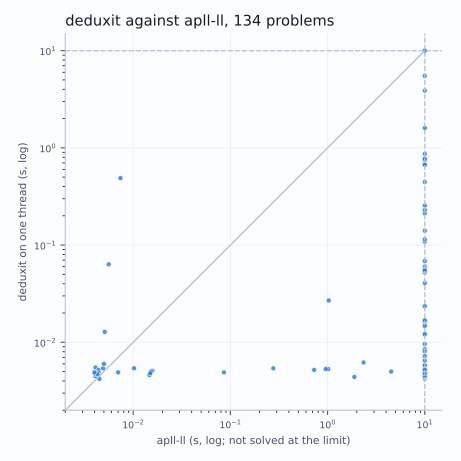
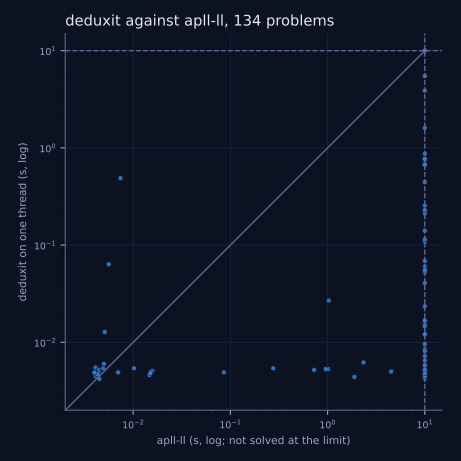
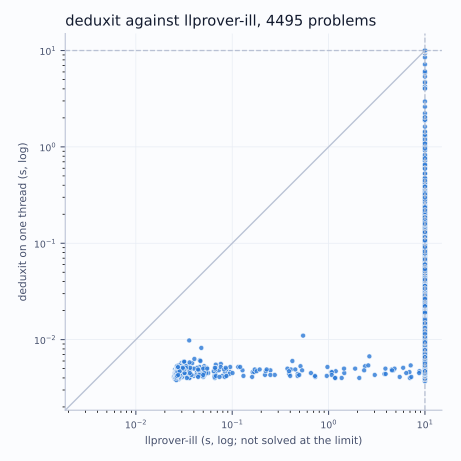
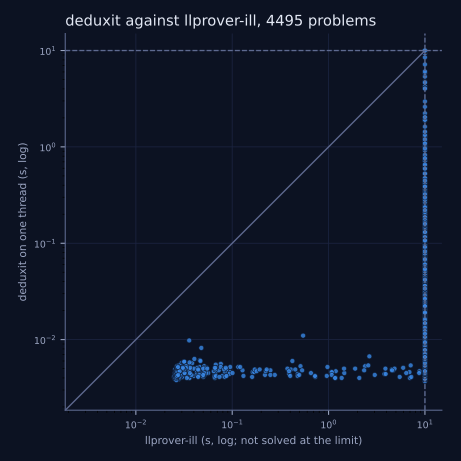
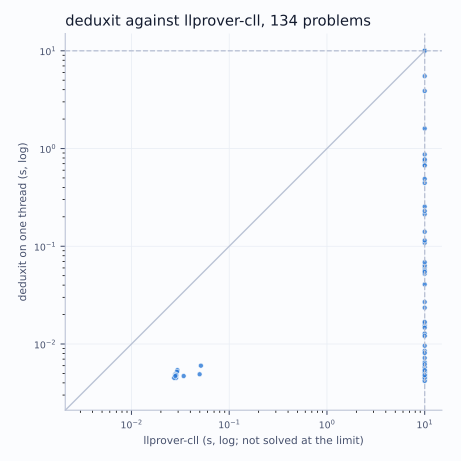
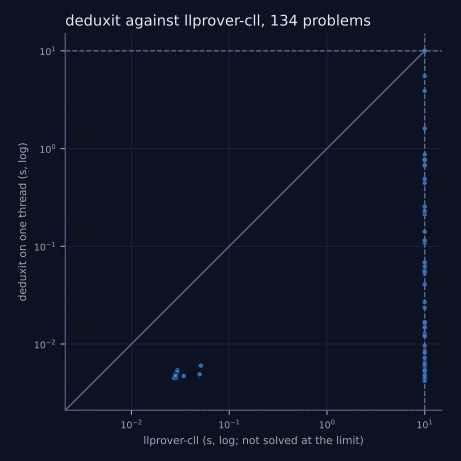
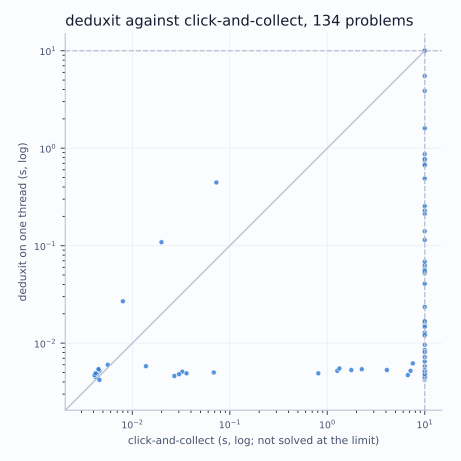
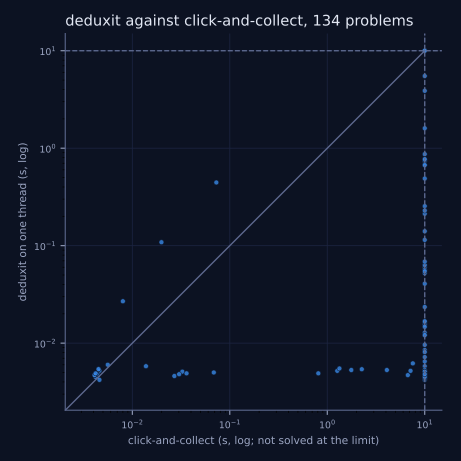
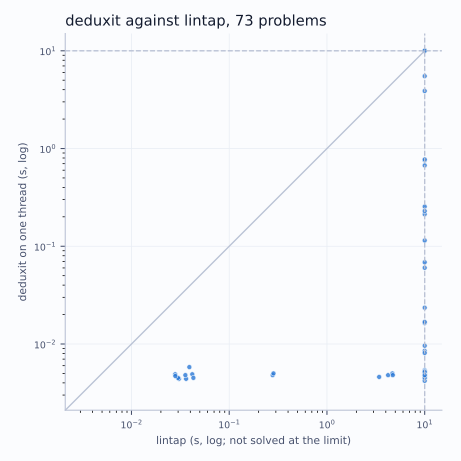
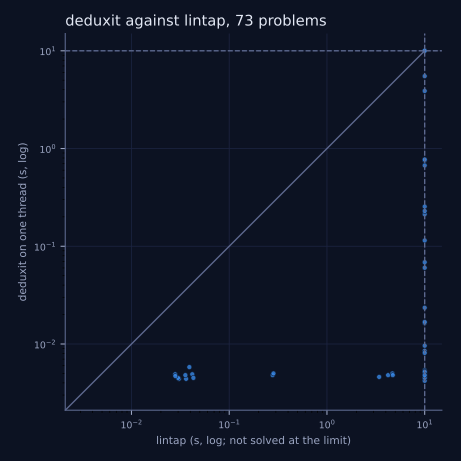
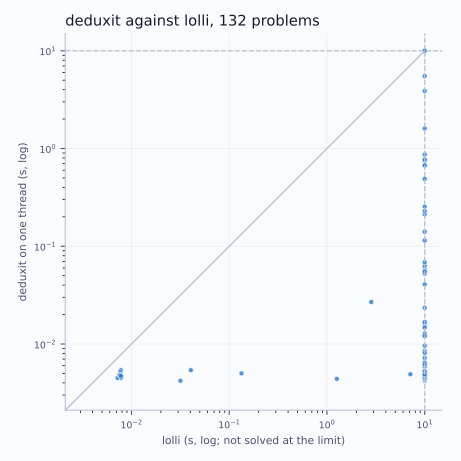
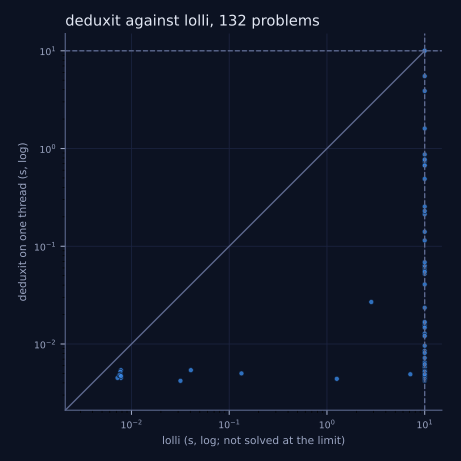
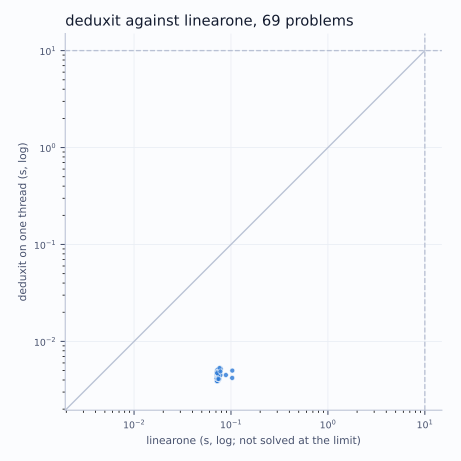
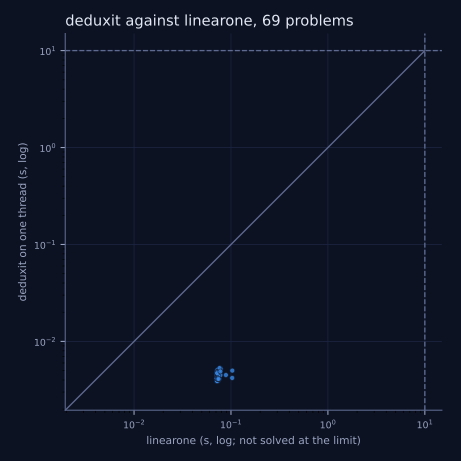
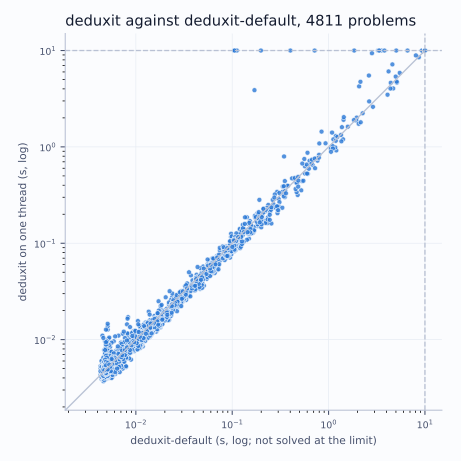
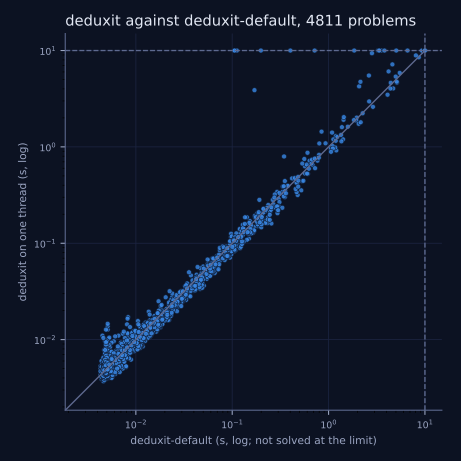
The scatter plots
Each plot sets deduxit on one thread against one tool on every problem both cover, a point per problem, the tool's time across and deduxit's up, both logarithmic; a problem not solved is drawn on the dashed line of the 10 s limit. A point below the diagonal is a problem deduxit solved faster. Against every other prover most points lie below it: of the 4 495 problems deduxit and Sympli both cover, deduxit is faster by more than a tenth on 3 294 and slower on 551, Sympli's refutations that deduxit leaves at its limit making the row along the top; against Maude, llprover, linTAP, lolli and LinearOne no point lies above it. Against deduxit's own default, which runs on the slower low-power cores and races a second search, most points lie on the diagonal.