The baseline of 2026-10-17
The third baseline of deduxit's engines, taken by bench/baseline.sh on
2026-10-17 from 19:32 for 2 h 58 min, at commit ed74387d9bf3, the
engines of the first release, in a release build on an Intel Core Ultra
X9 388H (16 cores, 62 GB). The sequential runs went in four streams at
once, each pinned to a performance core of its own; a time is the
median of up to three runs. Every proof of the baseline passed the
checker. The tables of every run are
bench/RESULTS.md,
the rows bench/results/2026-10-17/, and the three baselines compared
bench/COMPARISON.md,
from which the tables below are taken.
The families
The generated families, on one thread under a limit of 300 s
(families.csv); a run past 300 s went again under 1 200 s
(long-1.csv, long-2.csv):
| family | the third baseline |
|---|---|
| 3-partition-no (bins of b) | every size in under 1 ms (b = 5: 346 µs) |
| partition-yes (n items) | n = 24: 74.4 s, 28 > 1 200 s |
| partition-no | n = 12: 3.8 s, 14 and 15 > 300 s |
| qbf (n variables, four instances) | n = 48: three of four, 162–222 s (#3 refuted in 222 s; #0 at the memory bound after 85 s); qbf/44#3 at the memory bound |
| wide-m3 (k literals) | k = 2 048: 173 ms |
| wide-m4 | k = 2 048: 167 ms |
| mix (k pairs) | k = 10: 62.5 s (11 > 1 200 s) |
| counter (n tokens) | n = 64: 55 µs |
| counter-over | refuted at every size, 64 in 45 µs |
| chain (k clauses) | k = 256: 275 ms |
| additive (depth d) | d = 16: 182 ms |
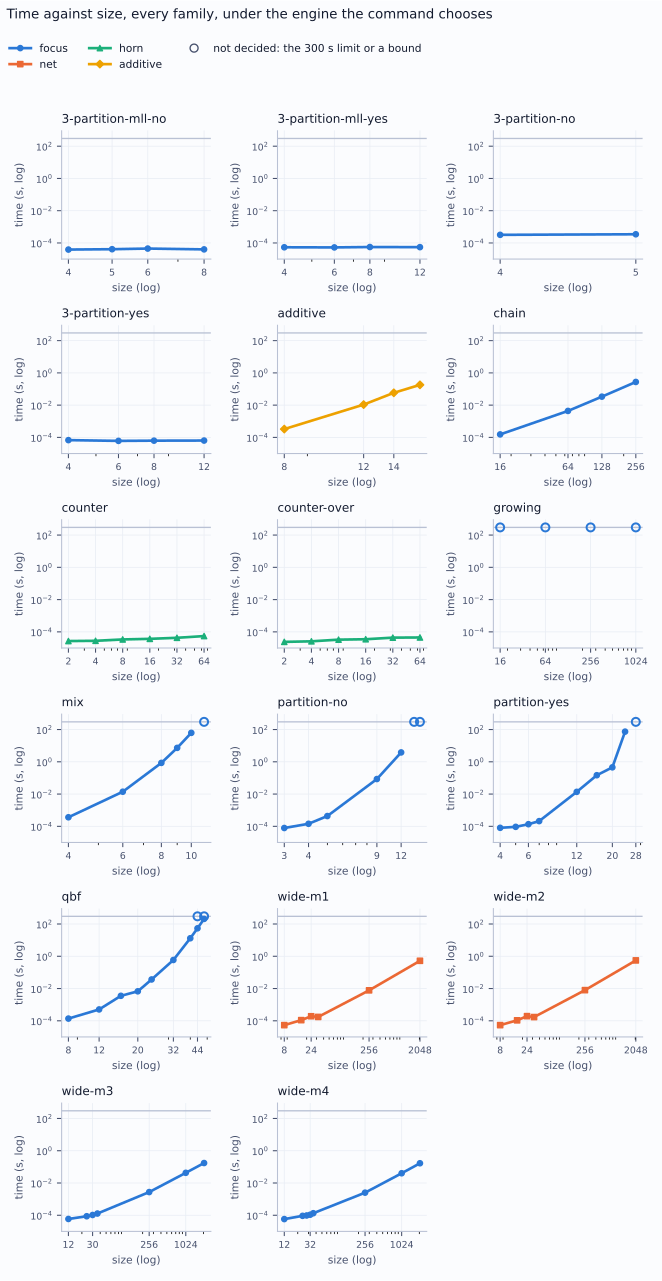
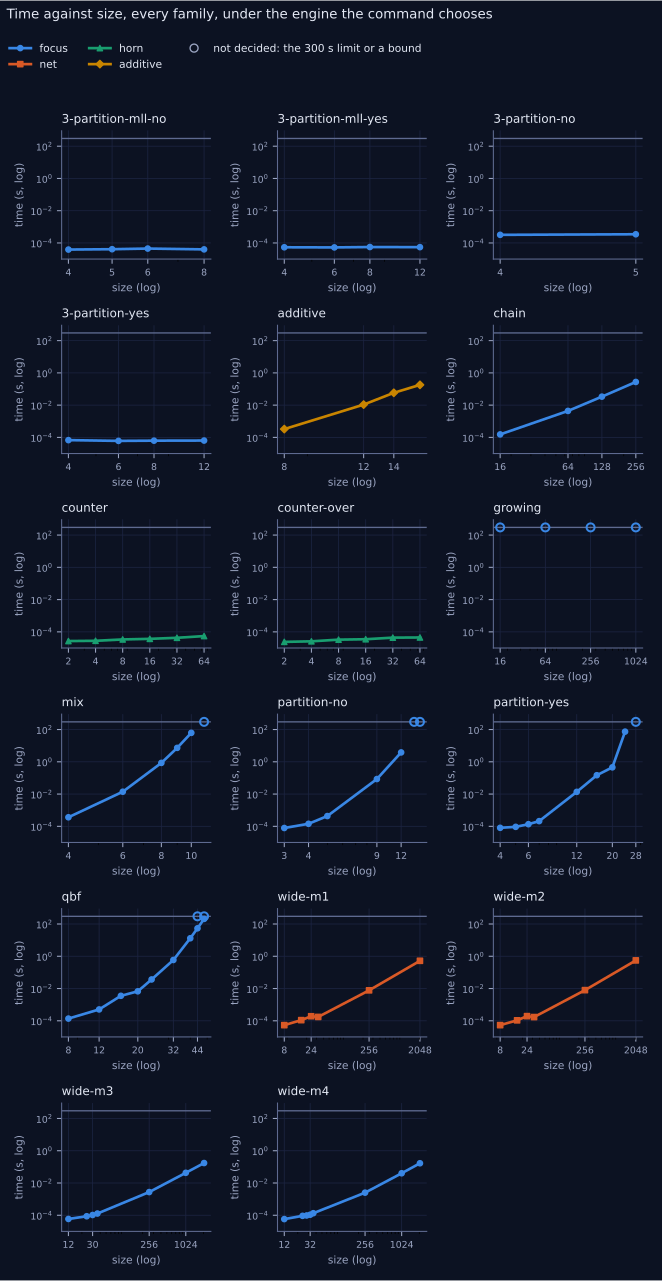
The families' time against their size. The wall time of every
generated family's instances under the engine the command chooses for
it, the median of the runs of families.csv above (one thread, 300 s),
both axes logarithmic, a line per engine; a size where most runs of
some instance ended undecided, at the time limit or a bound, is a
hollow marker on the limit's line. partition-yes, partition-no,
qbf and mix rise ever more steeply with their size, while the four
3-Partition families stay flat at tens to hundreds of microseconds; wide-m*, chain and
additive follow nearly straight lines on the two logarithmic axes, a
power of the size; counter and counter-over, Petri nets the Horn
engine searches by their markings, stay at tens of microseconds; and
growing ends at the copy bound or the recursion limit at every
size.
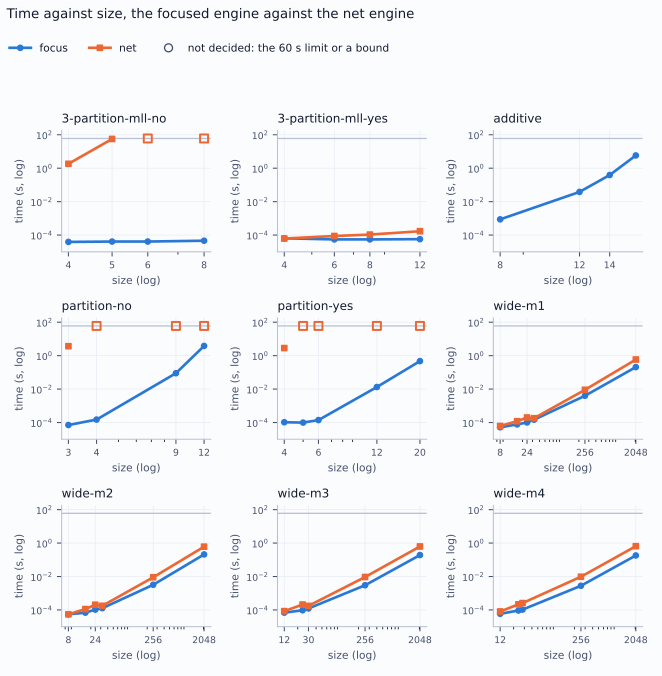
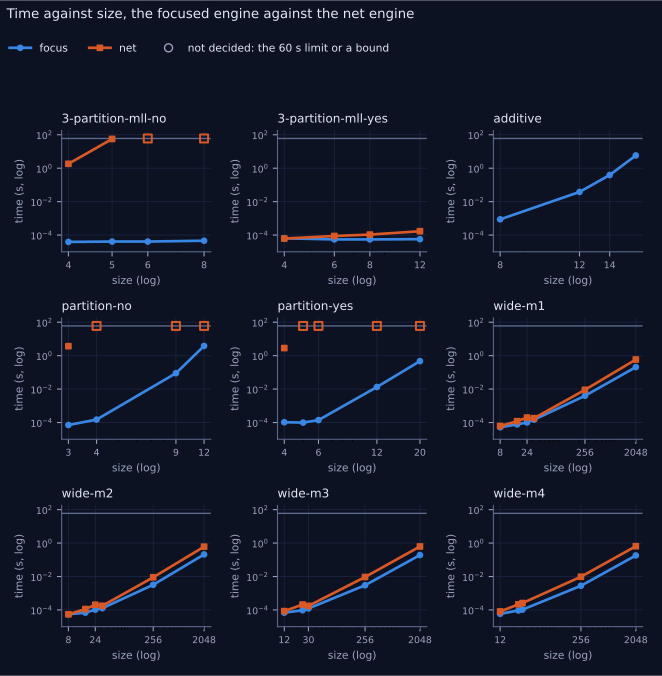
The focused engine against the net engine. The same measure for the
families of engines.csv, where the baseline forces each engine in
turn (one thread, 60 s, the same machine and run): the focused engine
decides every instance, where the net engine leaves partition-yes
and partition-no undecided past their smallest size and
3-partition-mll-no past size 5; on the wide families, two of which the command gives to the
net engine, the two grow alike, the focused engine a nearly constant
factor ahead. The net engine refuses additive, which has no proof
nets.
The LLTP library
Problems solved within 5 s on one thread, per pass (the counts of
bench/RESULTS.md's "Solved within the time limit", summed per file):
| pass | solved |
|---|---|
lltp-intuitionistic (4 495 problems, copy bound 3) | 3 610 |
lltp-classical (4 512) | 3 621 |
lltp-rarer (the backward search alone) | 3 608 |
lltp-forward (the forward search alone, 30 copies) | 4 026 |
lltp-copies-10 (1 003 that ended at the copy bound) | 592 |
lltp-recursion (995 that ended at the recursion limit) | 895 |
lltp-all-cores (1 102, every core) | 993 |
lltp-default (4 495, the command's default, 2 s) | 4 024 |
The Petri nets make most of it: 3 071 of 3 137 in the intuitionistic pass. The pass under the command's default (no copy bound, one thread for 0.1 s and then a pool of the other fifteen beside it, 2 s) decides 4 024 of the 4 495 problems: 3 069 nets and 955 others.