First order against LinearOne, 2026-10-30
deduxit's first-order families against LinearOne, Moot's prover of
first-order MILL, the only other prover of first-order linear logic
that the comparison runs: lambek-fo (the Lambek calculus in Moot and
Piazza's translation into MILL1, at 16, 64, 256 and 512 formulas, five
shapes) and witness-fo (a witness among 4, 8, 10 and 12, four shapes,
of which LinearOne's fragment holds the MILL1 shapes #2 and #3).
bench/TOOLS.md
says how the problems are translated and discusses the verdicts.
The times are bench/comparison/first-order/times-1.csv and
times-2.csv: on 2026-10-30, linlog-bench run --tools linlog,linearone --family lambek-fo --family witness-fo --timeout 10 --memory-limit 4294967296 (the harness and the command were named
linlog then) in two shards on cores 2 and 3 of an
otherwise quiet Intel Core Ultra X9 388H, measured by runexec 3.35, one
run per problem, linlog on one thread. The run did not record the
commit of linlog's build (its env.json leaves linlog_commit empty);
the rows were committed in af34ca95711d.
| tool | in its fragment | proved | unprovable | undecided | wrong |
|---|---|---|---|---|---|
| deduxit, one thread | 36 | 18 | 15 | 3 | 0 |
| LinearOne | 28 | 16 | 12 | 0 | 0 |
On the 25 problems both decide the verdicts are equal, and every
verdict of either equals the family's by construction. deduxit takes
4.0 ms in the median and LinearOne 51 ms, deduxit the faster on 24;
LinearOne's floor of about 46 ms is SWI-Prolog's start. LinearOne alone
decides three: lambek-fo/512 #0 and #2, where deduxit's two-sided
search meets its recursion limit of 2 048, and witness-fo/12#3, which
deduxit leaves at the time limit.
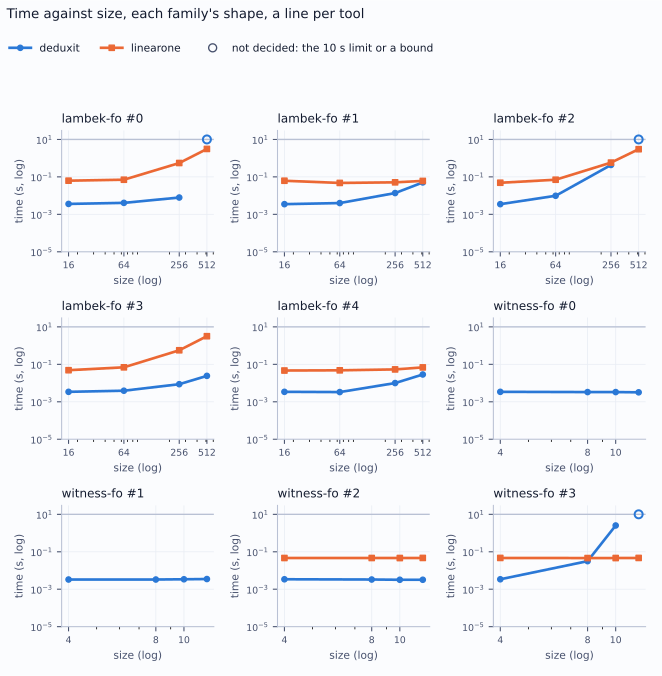
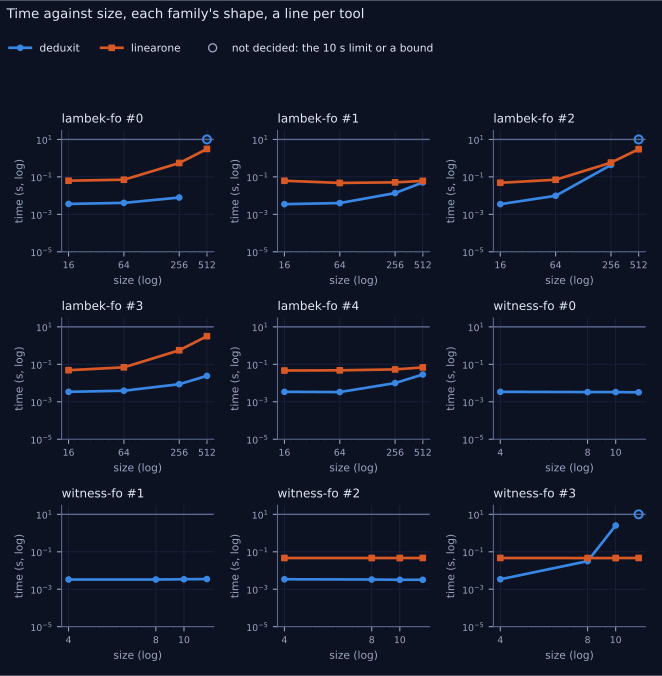
Time against size. The wall time of each shape of the two families
against its size, both logarithmic, a line per tool; a size not
decided within 10 s is a hollow marker on the limit's line, and a shape
outside LinearOne's fragment (witness-fo #0 and #1) has deduxit's line
alone. deduxit is ten to twenty times faster at the smallest sizes; on
lambek-fo it grows more slowly than LinearOne on #0 and #3 and faster
on #1, #2 and #4, the two meeting at the largest sizes of #1 and #2;
deduxit loses on witness-fo #3, whose time rises steeply from size 8,
and at size 512 of lambek-fo #0 and #2.
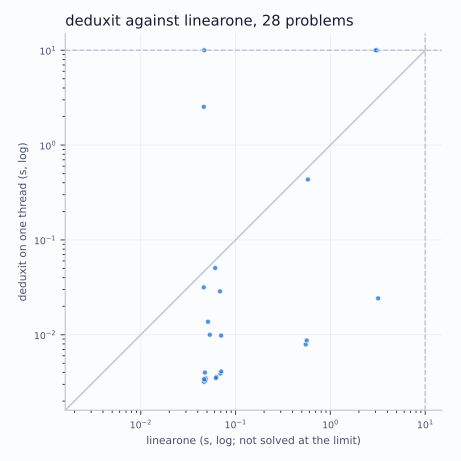
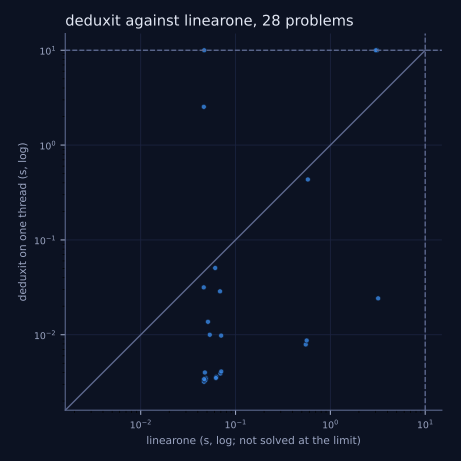
deduxit against LinearOne. A point per problem both cover, LinearOne's
time across and deduxit's up, a problem not solved on the dashed line of
the 10 s limit: all but four lie below the diagonal, and those four are
the three deduxit leaves undecided and witness-fo/10#3, 2.5 s against
LinearOne's 46 ms.
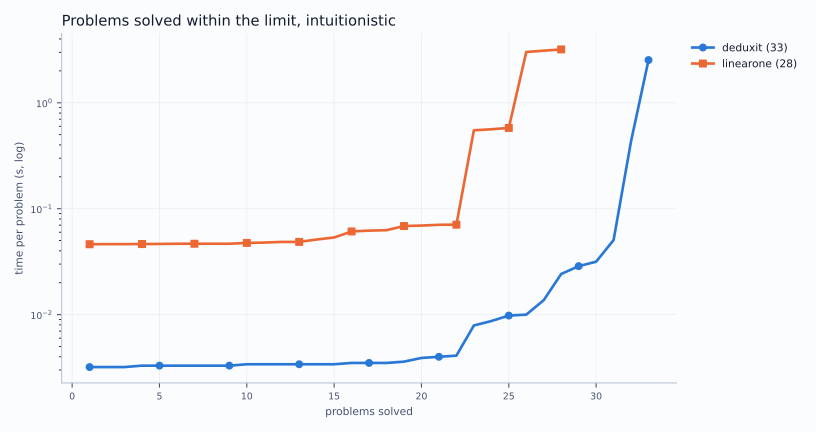
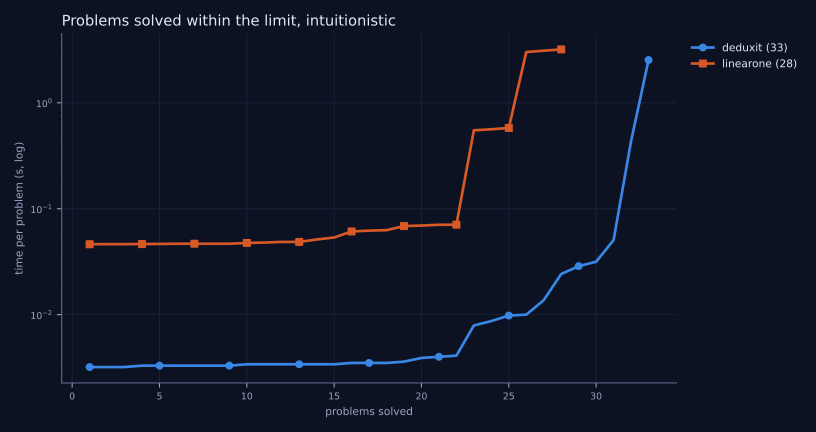
Problems solved within the limit. Each tool's problems solved within 10 s, sorted by time: deduxit solves 33 of its 36, LinearOne 28 of its 28.