Families that grow, 2026-11-02
The growing sets of Families that grow, 2026-10-31
again, at the sizes extended since and with the classical shape of
duplicate, from the engines of 0.2.0: each family chosen with a claim,
the strength or the weakness of one engine or of another prover, which
the growth of the time to decide the family shows. That chapter says
what each family is and what its claim and comparison are;
deduxit-bench families prints each family's sizes and claim.
The engines
The times are bench/growing/2026-11-02/: on 2026-11-02 from 16:59 to
17:28, bench/growing.sh --cores 2,3 --pool-cores 2-3 --timeout 60,
two sequential streams pinned to CPUs 2 and 3, two performance cores of
an Intel Core Ultra X9 388H, and the pool pass on both of them (so "2
threads"), with the build of deduxit that took
the baseline of the same day (commit
a917eaf4772d), one run per problem. It ran by day, right after that
baseline, while two other projects' sessions worked on the machine's
efficiency cores; nothing kept other processes off CPUs 2 and 3.
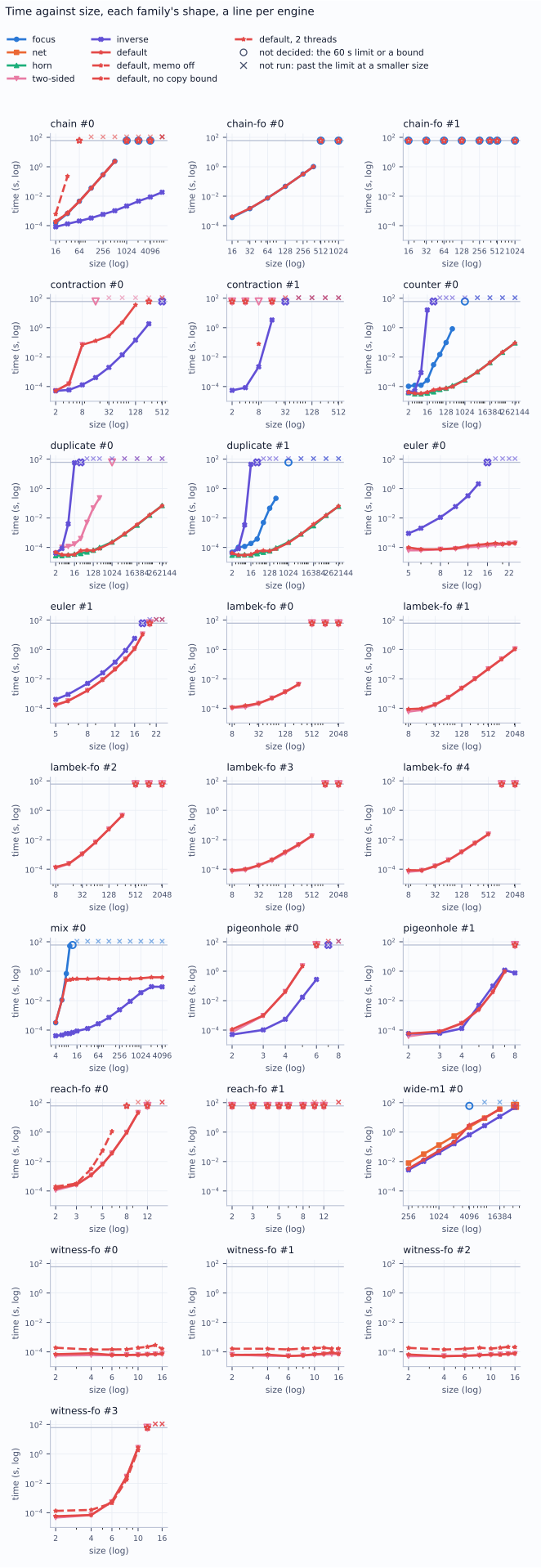
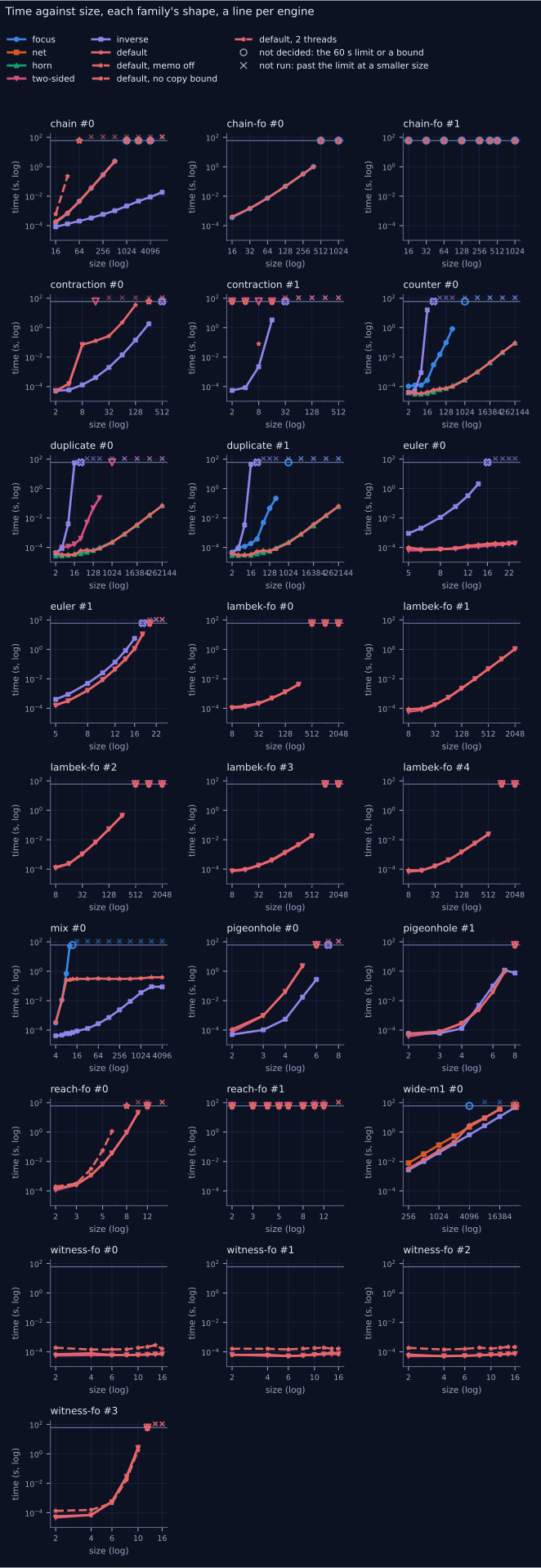
Time against size. The search time of each family's shape against its size, both logarithmic, a line per configuration: the default and every engine that admits the shape, forced; the memo switched off, no copy bound and two threads dashed in their engine's colour; a size not decided within 60 s a hollow marker on the limit's line; a size not run because the line met the limit at a smaller one a small cross above it.
What it shows is what the run of 2026-10-31 showed: every line that both runs drew ends at the same size, its largest decided size taking within a quarter of the earlier time where that was over a millisecond, apart from the sizes added since; so each claim stands as that chapter states it. What is new, each from the rows:
mix: the inverse method forced decides 4 096 pairs in 87 ms, and the default, after its turn's 2²⁴ units of work, 4 096 in 0.39 s, flat from 8 pairs on; the focused engine alone grows about eightfold per pair, as before.chain: the inverse method forced decides 8 192 clauses in 19 ms, linear; the default and the focused engine still meet the recursion limit at 1 024.contraction#0: the inverse method forced decides 256 atoms in 1.8 s and meets its memory bound at 512.lambek-fo#1, refuted, takes 1.1 s at 2 048 formulas.duplicate#1, the same sequent classically: the Horn engine decides 262 144 factors in 63 ms, as the default does; the focused engine forced 256 in 0.22 s and passes the minute at 1 024; the inverse method forced takes 44 s at 16 and passes the minute at 32.
The fitted growth of each line, over its sizes solved in more than a
millisecond (n^d a polynomial, b^n an exponential, whichever fits the
logarithm of the time better):
| shape | line | sizes fitted | fitted growth |
|---|---|---|---|
| chain #0 | focus | 64 to 512 | n^3.0 |
| chain #0 | inverse | 512 to 8192 | n^1.0 |
| chain #0 | default | 64 to 512 | n^3.0 |
| chain #0 | default, memo off | — | fewer than 3 sizes solved over 1 ms |
| chain #0 | default, no copy bound | 64 to 512 | n^3.0 |
| chain-fo #0 | focus | 32 to 384 | n^2.7 |
| chain-fo #0 | default | 32 to 384 | n^2.6 |
| chain-fo #1 | focus | — | fewer than 3 sizes solved over 1 ms |
| chain-fo #1 | default | — | fewer than 3 sizes solved over 1 ms |
| contraction #0 | two-sided | — | fewer than 3 sizes solved over 1 ms |
| contraction #0 | inverse | 32 to 256 | n^3.3 |
| contraction #0 | default | 8 to 128 | 1.05^n |
| contraction #1 | two-sided | — | fewer than 3 sizes solved over 1 ms |
| contraction #1 | inverse | — | fewer than 3 sizes solved over 1 ms |
| contraction #1 | default | — | fewer than 3 sizes solved over 1 ms |
| counter #0 | focus | 32 to 256 | n^2.7 |
| counter #0 | horn | 4096 to 262144 | n^1.1 |
| counter #0 | inverse | — | fewer than 3 sizes solved over 1 ms |
| counter #0 | default | 16384 to 262144 | n^1.1 |
| duplicate #0 | horn | 16384 to 262144 | n^1.1 |
| duplicate #0 | two-sided | 64 to 256 | n^2.8 |
| duplicate #0 | inverse | — | fewer than 3 sizes solved over 1 ms |
| duplicate #0 | default | 16384 to 262144 | n^1.1 |
| duplicate #1 | focus | 64 to 256 | n^2.7 |
| duplicate #1 | horn | 16384 to 262144 | n^1.1 |
| duplicate #1 | inverse | — | fewer than 3 sizes solved over 1 ms |
| duplicate #1 | default | 16384 to 262144 | n^1.0 |
| euler #0 | two-sided | — | fewer than 3 sizes solved over 1 ms |
| euler #0 | inverse | 6 to 14 | 2.37^n |
| euler #0 | default | — | fewer than 3 sizes solved over 1 ms |
| euler #1 | two-sided | 8 to 18 | 2.37^n |
| euler #1 | inverse | 8 to 16 | 2.41^n |
| euler #1 | default | 8 to 18 | 2.36^n |
| lambek-fo #0 | two-sided | — | fewer than 3 sizes solved over 1 ms |
| lambek-fo #0 | default | — | fewer than 3 sizes solved over 1 ms |
| lambek-fo #1 | two-sided | 128 to 2048 | n^2.2 |
| lambek-fo #1 | default | 128 to 2048 | n^2.2 |
| lambek-fo #2 | two-sided | 32 to 256 | n^2.9 |
| lambek-fo #2 | default | 32 to 256 | n^2.9 |
| lambek-fo #3 | two-sided | 128 to 512 | n^1.9 |
| lambek-fo #3 | default | 128 to 512 | n^1.8 |
| lambek-fo #4 | two-sided | 128 to 512 | n^2.0 |
| lambek-fo #4 | default | 128 to 512 | n^2.0 |
| mix #0 | focus | 6 to 10 | 8.27^n |
| mix #0 | inverse | 256 to 4096 | n^1.4 |
| mix #0 | default | 6 to 4096 | n^0.2 |
| pigeonhole #0 | two-sided | — | fewer than 3 sizes solved over 1 ms |
| pigeonhole #0 | inverse | — | fewer than 3 sizes solved over 1 ms |
| pigeonhole #0 | default | — | fewer than 3 sizes solved over 1 ms |
| pigeonhole #1 | two-sided | 5 to 7 | 20.07^n |
| pigeonhole #1 | inverse | 5 to 8 | n^11.6 |
| pigeonhole #1 | default | 5 to 7 | 19.37^n |
| reach-fo #0 | two-sided | 4 to 10 | 5.11^n |
| reach-fo #0 | default | 4 to 10 | 5.09^n |
| reach-fo #0 | default, memo off | 4 to 6 | 18.75^n |
| reach-fo #1 | two-sided | — | fewer than 3 sizes solved over 1 ms |
| reach-fo #1 | default | — | fewer than 3 sizes solved over 1 ms |
| reach-fo #1 | default, memo off | — | fewer than 3 sizes solved over 1 ms |
| wide-m1 #0 | focus | 256 to 2048 | n^2.0 |
| wide-m1 #0 | net | 256 to 16384 | n^2.0 |
| wide-m1 #0 | inverse | 256 to 32768 | n^2.0 |
| wide-m1 #0 | default | 256 to 16384 | n^2.3 |
| witness-fo #0 | two-sided | — | fewer than 3 sizes solved over 1 ms |
| witness-fo #0 | default | — | fewer than 3 sizes solved over 1 ms |
| witness-fo #0 | default, 2 threads | — | fewer than 3 sizes solved over 1 ms |
| witness-fo #1 | two-sided | — | fewer than 3 sizes solved over 1 ms |
| witness-fo #1 | default | — | fewer than 3 sizes solved over 1 ms |
| witness-fo #1 | default, 2 threads | — | fewer than 3 sizes solved over 1 ms |
| witness-fo #2 | two-sided | — | fewer than 3 sizes solved over 1 ms |
| witness-fo #2 | default | — | fewer than 3 sizes solved over 1 ms |
| witness-fo #2 | default, 2 threads | — | fewer than 3 sizes solved over 1 ms |
| witness-fo #3 | two-sided | — | fewer than 3 sizes solved over 1 ms |
| witness-fo #3 | default | — | fewer than 3 sizes solved over 1 ms |
| witness-fo #3 | default, 2 threads | — | fewer than 3 sizes solved over 1 ms |
The other provers
The other provers ran on these growing sets to their limits on
2026-11-03, beside the engines of the same release:
the other provers on the growing sets, 2026-11-03
has their figure of time against size, their fitted growth and their
cactus and scatter plots. It adds where each family's claim about
another prover shows (no other tool passes 8 factors of duplicate but
Sympli), what they decide that deduxit does not (LinearOne 8 problems of
lambek-fo and witness-fo), and why Click & coLLecT and APLL refute
wide-m1: an overflow in their search from 63 formulas beside a ⊗.
The check of every tool on each set's first two sizes is
the chapter of 2026-10-31,
and the comparison with the other provers on the libraries is
that of 2026-10-15, of the engines of 0.1.0.